Pease Pottage 01403 275 276
Petersfield 01730 777 350
Maidstone 01795 843 866
Cullompton 01884 211 788

Why Use Geotextile for Road Construction?

Road construction often begins with an invisible problem: weak soil beneath the visible pavement. After heavy rain, fine soil can move upward into aggregate layers. Under repeated truck loads, the road may rut, crack, or lose its designed strength. Geotextile offers a practical way to control these risks. It can separate soil from gravel, filter water, support drainage, and improve load distribution. The result is not always dramatic on opening day. Its value appears later, when the road remains firm after storms and seasonal traffic.

Dr. Robert M. Koerner, a leading geosynthetics educator, has explained that geotextiles provide separation, filtration, drainage, reinforcement, and protection functions. These functions depend on the project. A woven geotextile may improve tensile support over soft ground. A nonwoven geotextile may allow water to pass while retaining fine particles. Selection must consider soil type, water movement, traffic volume, installation conditions, and required service life. One fabric cannot solve every road problem.

That assumption needs correction.

On site, a damaged roll or poorly overlapped joint can reduce performance. Construction teams must inspect the subgrade, remove sharp debris, control wrinkles, and follow the specified overlap. Engineers should also verify strength, permeability, and puncture resistance through appropriate testing. Geotextile is not a magic sheet. It is a designed component within a drainage and pavement system. Used carefully, it can reduce maintenance, protect aggregate, and extend road performance. Still, every project deserves review, because local soil and rainfall can challenge even a sound design.
Why Use Geotextile for Road Construction?

What Is Geotextile and How Does It Work in Road Construction?

Why Use Geotextile for Road Construction?

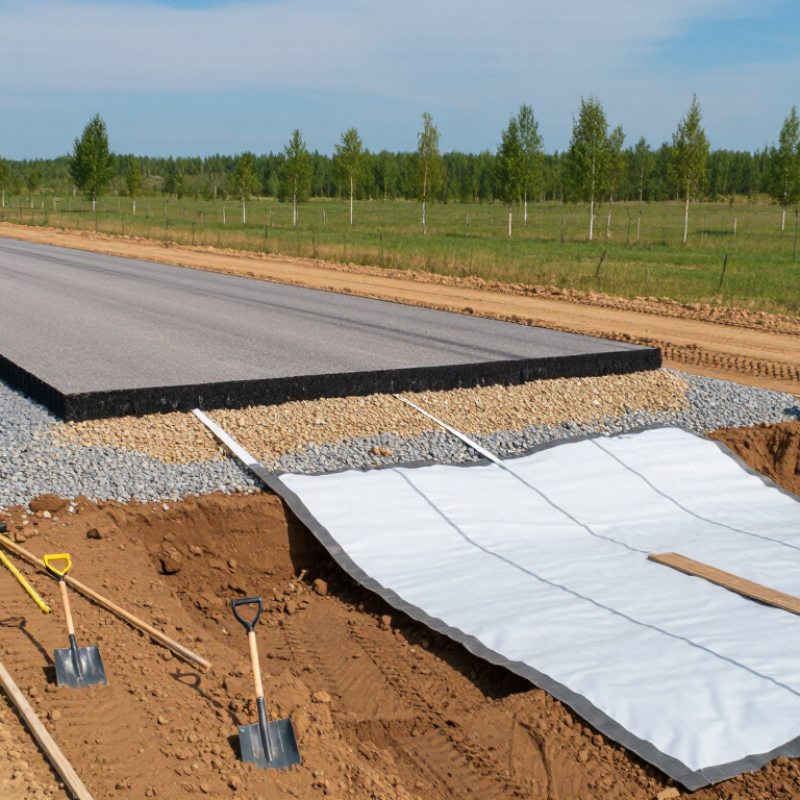
Geotextile is a permeable synthetic fabric placed between soil layers during road construction. It separates weak subgrade soil from crushed stone, while allowing water to pass through. This prevents fine soil particles from rising into the aggregate layer. The road keeps its designed thickness for longer.

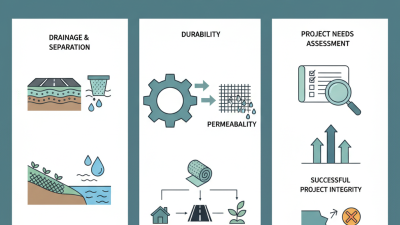
Its function depends on the fabric type and site conditions. Separation protects the road structure. Filtration controls soil movement around drainage paths. Reinforcement spreads vehicle loads across soft ground. Drainage fabrics can also reduce trapped water beneath the pavement.

On site, installers should remove sharp debris before placement. Overlaps must remain secure, especially near curves and construction joints. It is not a miracle fix. Poor grading, blocked outlets, or incorrect specifications can still cause cracking and rutting.

Tips: Test the subgrade before selecting fabric strength. Check water flow after heavy rain. Use clean, well-graded aggregate above the fabric. Avoid dragging machinery directly across exposed geotextile. Small installation mistakes matter. Designers should verify tensile strength, opening size, permeability, and expected traffic loads. Local soil behavior can change quickly, so laboratory data and field observations should work together. In practice, a practical design may need adjustment after excavation reveals wetter or weaker soil than expected.
Which Road Problems Can Geotextile Help Solve?

Roads often fail from below, not above. Water weakens subgrade soil, while traffic presses aggregates into soft ground. FHWA’s 2023 Conditions and Performance Report found that 43% of U.S. public roads were in poor or mediocre condition in 2021. Geotextile can address several causes behind that deterioration.

It separates road aggregate from clay and silt. This prevents pumping, where muddy soil rises through the base under repeated wheel loads. It also distributes stress across weak areas, helping reduce ruts and settlement. In wet construction zones, a permeable geotextile allows water to drain while retaining soil particles. AASHTO M 288 provides performance categories for separation, filtration, drainage, and reinforcement applications.

The installation details matter greatly. Poor overlaps, sharp stones, or trapped wrinkles can create early failure points. Field guidance from the Federal Highway Administration emphasizes proper subgrade preparation, anchoring, and aggregate placement. A geotextile cannot repair a badly designed drainage system. That limitation is easy to overlook. Contractors should verify soil strength, expected traffic, rainfall, and material properties before selection. ASTM D4759 also recommends confirming geosynthetic properties through documented testing. In practice, the cheapest fabric may become expensive when rutting returns after one rainy season.

How Is Geotextile Installed Beneath and Within Roads?

Why Use Geotextile for Road Construction?

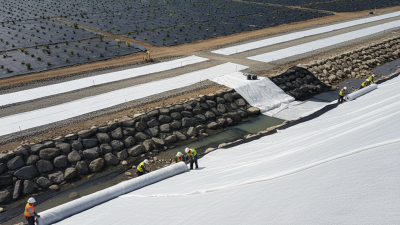
Geotextile installation begins with a prepared subgrade. Workers remove sharp stones, roots, and standing water before unrolling the fabric. The surface must be firm enough to prevent punctures during aggregate placement. FHWA’s Geosynthetic Design and Construction Guidelines recommend selecting survivability requirements according to soil conditions, equipment, and construction stress.

The fabric should lie flat, without folds or stretched sections. Adjacent rolls commonly overlap by 300 to 600 millimeters, although the design may require more. AASHTO M 288-22 classifies geotextiles by filtration, separation, drainage, and installation survivability needs. Field crews should secure overlaps with pins or temporary ballast, especially during windy weather. Small errors matter.

Aggregate must be placed carefully. Dump trucks should avoid driving directly on exposed geotextile. Operators typically place the first lift from the edge or over previously covered areas, then spread it with low-impact equipment. FHWA guidance warns that uncontrolled dumping can tear or displace the fabric. After compaction, geotextile may also sit within drainage layers or between aggregate courses, where it filters water and limits soil migration. Installation records should include roll numbers, overlap measurements, damaged areas, and repair locations. In practice, inspections are sometimes rushed, and that is a weakness worth admitting. A torn section should be patched with the same material, extending beyond the damage on every side. Geotextile is not a shortcut for poor grading or weak drainage design.

Why Use Geotextile for Road Construction? - How Is Geotextile Installed Beneath and Within Roads?

Road Construction Area Primary Function Typical Geotextile Type Installation Position Important Installation Requirements Main Construction Benefit
Weak subgrade Separates soft soil from the aggregate layer and limits mixing caused by traffic and construction equipment. Woven or nonwoven polypropylene or polyester geotextile, selected according to the design loads and soil conditions. Directly on the prepared subgrade, beneath the subbase or base course. Remove sharp debris, eliminate standing water, keep the fabric reasonably smooth, and place aggregate without damaging or displacing the fabric. Improves aggregate stability and helps preserve the designed thickness of the road structure.
Separation between subgrade and aggregate Prevents fine soil particles from migrating upward into clean granular material while allowing water to pass when the fabric is permeable. Nonwoven geotextile for filtration and separation; woven geotextile where higher tensile strength is required. At the interface between the natural soil and the imported granular layer. Overlap adjacent panels according to the project specification; commonly used overlaps are about 300–600 mm, with larger overlaps where subgrade conditions are poor. Reduces contamination of the aggregate and can support more consistent drainage and compaction.
Pavement drainage layer Filters soil particles while retaining drainage aggregate and allowing excess water to move toward a drainage outlet. Hydrophilic nonwoven geotextile with suitable apparent opening size and water permeability. Around or beneath a free-draining aggregate layer, edge drain, or collector drain. Use a continuous filter layer, seal or overlap joints as specified, and avoid folds that could restrict drainage. Helps reduce the buildup of pore water and protects drainage aggregate from clogging by soil fines.
Road widening and pavement reconstruction Creates a separation layer between old and new materials and helps accommodate differences in soil or aggregate properties. Woven or high-strength composite geotextile, depending on settlement and tensile requirements. Across the prepared widening area or at the interface between existing and new pavement layers. Prepare a firm, even surface; extend the fabric beyond the treatment area where specified; protect it from construction traffic and ultraviolet exposure. Promotes more uniform behavior between adjoining pavement sections and reduces material intermixing.
Paved road asphalt rehabilitation Acts as a stress-relieving interlayer that can slow the reflection of existing cracks into a new asphalt overlay. Specialized paving geotextile or geocomposite designed for asphalt applications. Between the existing pavement and the new asphalt overlay, normally installed with an asphalt tack or bonding treatment. Clean and repair the existing surface, apply the specified binder uniformly, remove wrinkles, and place the overlay after proper bonding. May extend pavement service life by delaying crack reflection and helping manage limited moisture intrusion.
Embankment over soft ground Provides tensile support and separation while the embankment is constructed over compressible or weak soil. High-strength woven geotextile or geogrid-geotextile composite selected through geotechnical design. At the base of the embankment, usually extending across the designed treatment zone. Install on a cleared surface, maintain the specified orientation and overlaps, control fill placement thickness, and monitor settlement during construction. Improves short-term construction stability and helps distribute embankment loads over weak soils.
Shoulders and unpaved access roads Separates the shoulder aggregate from the subgrade and helps reduce rutting under repeated vehicle loads. Woven geotextile for reinforcement and separation, or nonwoven geotextile where filtration is the primary need. Beneath the shoulder aggregate or gravel wearing course. Extend the fabric to the design limits, overlap seams, place aggregate from the edge or from an approved access area, and compact in controlled lifts. Reduces rut formation, aggregate loss, and the frequency of maintenance grading.
Erosion-prone slopes and drainage channels Filters soil beneath riprap or erosion-control cover while reducing soil loss caused by flowing water. Nonwoven filtration geotextile with appropriate puncture resistance and permeability. Between the prepared soil surface and riprap, gabions, or another protective facing. Anchor edges and overlaps, maintain intimate contact with the soil, and place protective cover carefully to prevent punctures or tearing. Protects the slope or channel while maintaining subsurface water movement.
Typical installation sequence Ensures the geotextile performs as designed throughout the road system. Product selected from project-specific strength, filtration, permeability, and durability requirements. Prepared formation → geotextile placement → panel joining or overlapping → aggregate or pavement layer placement. Inspect the subgrade, unroll in the specified direction, minimize wrinkles, secure exposed edges, repair damaged areas, and cover the fabric promptly. Provides reliable separation, filtration, reinforcement, or drainage performance when installed according to the design.

Note: Geotextile selection, strength requirements, seam overlaps, drainage properties, and cover thickness should be confirmed by the project geotechnical and pavement design.

What Types of Geotextile Are Used for Road Projects?

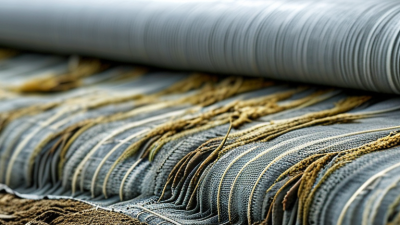
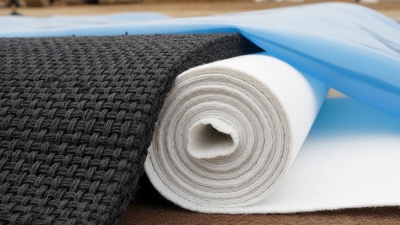
Road projects use several geotextile types because soil conditions rarely stay uniform. Woven geotextiles have tightly arranged yarns and high tensile strength. They suit separation and reinforcement beneath heavy traffic lanes.

FHWA’s Geosynthetic Design and Construction Guidelines identify tensile strength and soil interaction as key selection factors. A woven layer can prevent soft subgrade soil from mixing with crushed aggregate.

Nonwoven geotextiles use randomly bonded fibers. Their open structure supports filtration and drainage around ditches, culverts, and retaining structures.

ASTM D4751 evaluates apparent opening size, while ASTM D4491 measures permittivity. These tests connect laboratory performance with water movement through the fabric. It matters after intense rain.

Knitted geotextiles are less common in ordinary road bases but can provide specialized reinforcement. Composite geotextiles combine fabric with drainage cores or other geosynthetic layers.

FHWA guidance also stresses checking survivability during placement, not only catalog strength. A strong roll can still fail under sharp aggregate. I have seen specifications overlook installation damage. That weakness deserves attention.

Designers should compare soil gradation, water pressure, traffic loading, and construction equipment before selecting the type. Reports from the Federal Highway Administration consistently treat site-specific testing as more reliable than choosing fabric by weight alone.

What Are the Main Benefits and Limitations of Geotextile?

Geotextile helps road builders control the behavior of weak soil beneath pavement. It separates native soil from crushed aggregate, preventing the layers from mixing under repeated truck loads. On a wet site, this separation can preserve aggregate thickness and reduce rutting. The fabric also filters water while retaining fine soil particles. Proper drainage matters more than many projects admit.

Installation quality strongly affects performance. I have seen fabric tear when workers dragged sharp stone across an exposed subgrade. Overlaps must remain adequate, and wrinkles should be removed before aggregate placement. A qualified engineer should select the fabric by strength, permeability, and soil conditions. One material cannot suit every road.

Geotextile has clear limitations. It cannot repair poor drainage or replace a properly designed pavement structure. Clogged pores may reduce filtration when clay migrates into the fabric. Long exposure to sunlight can weaken some products, while construction traffic may puncture them. Extra labor and material costs also affect small projects. Sometimes, thicker aggregate or improved drainage is the better choice. Careful field testing is still needed.