Top Non Woven Geotextile Manufacturers for Global Buyers?
Choosing among the top non woven geotextile manufacturers requires more than comparing prices or browsing attractive product photographs. Global buyers need dependable evidence, practical experience, and clear technical communication. A geotextile may look identical in two samples, yet its mass, pore structure, tensile strength, and puncture resistance can differ significantly.
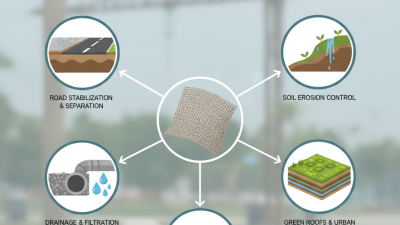
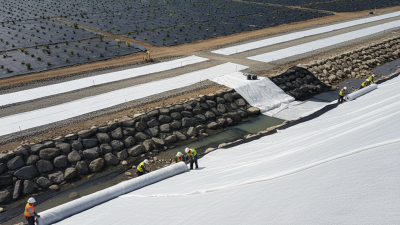
Dr. Robert M. Koerner, a respected authority in geosynthetics, stated, “The primary function of a geotextile is separation.” This principle remains highly relevant on construction sites. Beneath a gravel road, for example, a properly selected non woven geotextile helps prevent soil and aggregate from mixing. It can also support filtration, drainage, and reinforcement, depending on the project design.
Reliable manufacturers should explain these functions without exaggeration. They should provide laboratory test reports, production details, quality-control procedures, and consistent technical data. Buyers should examine needle-punching quality, roll dimensions, raw-material composition, UV resistance, and seam performance. Factory audits and independent testing can reveal weaknesses hidden behind polished catalogs.
Experience matters here. A supplier that understands muddy subgrades, sharp aggregate, heavy rainfall, and long-distance transport can offer more useful guidance. However, no supplier is perfect. Product selection still depends on site conditions, engineering calculations, installation methods, and local specifications. This article reviews leading non woven geotextile manufacturers for global buyers, focusing on measurable performance, manufacturing credibility, export capability, and responsive after-sales support. The goal is not to promote the loudest brand, but to identify suppliers that can perform reliably when the material is buried, loaded, and difficult to replace.

Define Nonwoven Geotextiles: Needle-Punched Fibers, AOS, and CBR Metrics
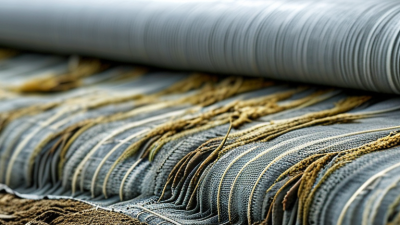
Nonwoven geotextiles are engineered fabrics made from randomly arranged polymer fibers. Needle punching mechanically entangles these fibers, creating a flexible, porous sheet. Polypropylene is common because it resists moisture and many soil chemicals. Polyester can provide higher strength, but site chemistry requires careful checking. Real projects expose weaknesses that laboratory samples may hide.
The key measurement is AOS, or Apparent Opening Size. ISO 12956 and ASTM D4751 use it to estimate the largest soil particle passing through the fabric. A smaller AOS usually improves filtration, but can clog faster in silty ground. CBR puncture resistance, measured under ISO 12236 or ASTM D6241, indicates how much force the fabric withstands before a plunger penetrates it. Higher CBR values generally suit angular aggregate and rough installation conditions. They do not automatically prove long-term durability.
Industry data also provides useful context. Grand View Research estimated the global geotextiles market at about USD 7.1 billion in 2023, with projected growth near 6.4% annually through 2030. That expansion increases purchasing pressure, sometimes encouraging specification shortcuts. A fabric with strong tensile data may still fail if its AOS mismatches the soil. Field engineers should review CBR, permittivity, mass, and seam performance together. One metric is never enough. I would also question unusually perfect test sheets; manufacturing variation, placement damage, and local soil grading deserve independent verification before global shipment.
Compare PP and PET Geotextiles Across 5 Key Engineering Performance Tests
For global buyers, comparing PP and PET nonwoven geotextiles requires more than checking unit price. Field engineers usually review five tests: tensile strength, puncture resistance, tear strength, permittivity, and apparent opening size. ASTM D4595 and ASTM D4632 measure tensile performance, while ASTM D4833 evaluates puncture resistance. PET commonly provides higher stiffness and tensile retention under heavy loading. PP usually offers lower density, strong chemical resistance, and easier handling. The FHWA Geosynthetic Design and Construction Guidelines, Report No. FHWA NHI-07-092, recommends evaluating geotextiles against site stresses, not catalogue values alone.
Puncture results matter beneath angular aggregate. Tear strength matters during placement and settlement. Permittivity controls water movement, while apparent opening size affects soil retention. ASTM D4491 covers permittivity, and ASTM D4751 covers apparent opening size. In practical trials, a PET fabric may resist stretching better, but alkaline exposure can reduce long-term confidence if the polymer and coating are poorly selected. PP can perform reliably, yet high temperatures may reduce dimensional stability. Real projects are less tidy. Laboratory rankings can change after installation damage, clogging, or repeated wetting.
Tips: Ask manufacturers for test reports, sample conditioning details, and machine-direction results. Check whether values are average or minimum. Request independent testing when drainage failure would be expensive. Compare mass per unit area only after confirming strength, filtration, and durability requirements. A cheaper roll may create higher installation risk. That possibility deserves honest review.
Top Non Woven Geotextile Manufacturers for Global Buyers? - Compare PP and PET Geotextiles Across 5 Key Engineering Performance Tests
| Engineering Performance Test |
Common Test Standard |
PP Nonwoven Geotextile
Typical Range |
PET Nonwoven Geotextile
Typical Range |
Engineering Interpretation for Global Buyers |
| Wide-Width Tensile Strength |
ASTM D4595 / ISO 10319
Unit: kN/m |
8–25 kN/m |
12–35 kN/m |
PET generally provides higher tensile capacity at comparable mass per unit area. It is often preferred for reinforcement and high-load separation applications. |
| Elongation at Break |
ASTM D4595 / ISO 10319
Unit: % |
50–100% |
30–70% |
PP typically accommodates greater deformation before rupture, which can be useful where installation strain or subgrade movement is expected. |
| CBR Puncture Resistance |
ASTM D6241 / ISO 12236
Unit: kN |
1.5–3.5 kN |
2.0–4.5 kN |
PET commonly offers higher puncture resistance, while both polymers can perform well when the fabric has adequate mass, needle-punching, and installation protection. |
| Trapezoidal Tear Strength |
ASTM D4533 / ISO 9073-4
Unit: kN |
0.4–1.2 kN |
0.6–1.5 kN |
Higher tear resistance helps limit damage caused by aggregate placement, handling, and localized construction stress. PET often has the higher range. |
| UV-Aged Tensile Retention |
ASTM D4355
500-hour exposure; retained strength: % |
50–75% |
70–90% |
PET generally retains strength better under prolonged sunlight exposure. PP should be stabilized and covered promptly when extended outdoor exposure is unavoidable. |
Data basis: The ranges above are representative engineering values for needle-punched staple-fiber nonwoven geotextiles approximately in the 300–600 g/m² mass range. Actual results vary with mass per unit area, fiber denier, bonding method, needle-punch density, polymer stabilization, test direction, and laboratory conditions. Product-specific technical data sheets and project design requirements should be used for final selection.
Verify Factory Capacity, ISO 9001 Systems, and Batch Quality Traceability
Global buyers need more than a product catalog when selecting non woven geotextile manufacturers. Factory capacity should be verified through production records, equipment lists, and recent shipment schedules. Ask how many needle-punching lines operate daily. Check actual output, roll widths, fabric weights, and storage conditions. A crowded warehouse may indicate demand, but it can also hide weak stock control.
An ISO 9001 certificate is useful evidence, not complete proof. Review its issuing body, scope, validity, and covered production site. Request procedures for incoming fiber checks, line inspections, tensile testing, and final release. Visit the laboratory if possible. Look for calibrated scales, thickness gauges, and strength-testing equipment. Small details matter.
Batch quality traceability should connect raw materials, machine settings, test results, operators, and shipment records. A clear lot code should appear on every roll label. Ask for retained samples and corrective-action reports from previous defects. Some records look perfect. That deserves questions. Manufacturing systems can fail during maintenance, shift changes, or urgent orders. A reliable supplier explains these weak points openly and shows how controls respond. Independent pre-shipment testing can add confidence, especially for large infrastructure projects. Yet testing one roll cannot represent careless production across an entire batch. Verify the system behind the sample.
Assess Export Compliance, Installation Support, MOQ, and Delivered Cost per m²
Selecting top non woven geotextile manufacturers requires more than comparing factory prices. Grand View Research reported that the global geotextiles market was valued at approximately USD 8.6 billion in 2023, with infrastructure projects driving continued demand. Yet market growth does not guarantee dependable exports. Buyers should request test reports for mass per unit area, tensile strength, puncture resistance, and apparent opening size. Independent testing is stronger evidence than a polished product sheet.
Export compliance needs practical verification. Check the correct HS classification, commercial invoice, packing list, country-of-origin documents, and destination labeling rules. For projects in Europe, ask whether applicable chemical and product requirements are addressed. Installation support also matters. A useful supplier should provide overlap guidance, subgrade preparation notes, anchoring details, and roll-handling instructions. A short video or drawing can prevent expensive field mistakes. Not every technical team explains clearly.
MOQ must match the project schedule. A low MOQ may carry a higher unit price, while a large MOQ can create storage and cash-flow pressure. Calculate delivered cost per m², not factory price alone: material, conversion, packaging, inland transport, freight, insurance, duties, and local delivery all belong in the equation. MarketsandMarkets has projected steady expansion in the wider geosynthetics sector, but freight volatility can still distort quotations. I would request three scenarios: port delivery, delivered-to-site, and delayed shipment. One overlooked unloading fee can change the decision. Supplier claims deserve verification.