Pease Pottage 01403 275 276
Petersfield 01730 777 350
Maidstone 01795 843 866
Cullompton 01884 211 788

What Are China Top Steel Panel Radiator Manufacturers?

China has become a major source of heating equipment, supported by its large steel-processing base and broad manufacturing network. The World Steel Association reported that China produced about 1.005 billion tonnes of crude steel in 2024. This scale matters because steel quality, forming capacity, and supply stability directly influence radiator production. However, steel volume alone does not prove radiator expertise.

A reliable Steel Panel Radiator manufacturer must demonstrate more than attractive catalog images. Buyers should examine panel thickness, weld consistency, corrosion protection, heat-output testing, and working-pressure performance. EN 442 provides a recognized framework for radiator thermal output and testing. ISO 9001 certification can support process control, but it is not a substitute for factory verification. Practical evidence remains important. Ask for test reports, production photographs, sample inspections, and export references. The International Energy Agency also highlights building efficiency as a key factor in reducing heating demand. Therefore, radiator selection should consider verified output, not only purchase price.

No ranking is permanently correct. Factory websites may overstate capacity, while trading companies may present themselves as manufacturers. This article reviews China’s leading Steel Panel Radiator manufacturers through production experience, technical documentation, certification, customization ability, and international service. It also considers details often missed during sourcing, such as uneven coating near welds, unclear warranty terms, and inconsistent packaging. Small flaws matter. UN Comtrade data can help examine trade activity, but trade statistics do not confirm factory quality. A balanced assessment requires documents, samples, audits, and buyer feedback. That is the more dependable path for importers, distributors, contractors, and heating-system professionals.
What Are China Top Steel Panel Radiator Manufacturers?

What Defines a High-Quality Steel Panel Radiator Manufacturer in China?

What Are China Top Steel Panel Radiator Manufacturers?

A high-quality Chinese steel panel radiator manufacturer proves performance, not just production capacity. China produced about 1.019 billion tonnes of crude steel in 2023, according to World Steel Association’s World Steel in Figures 2024. That scale supports strong material access, but it does not guarantee reliable radiators. Serious manufacturers control steel thickness, welding, degreasing, coating, and final inspection through documented procedures.

Look for thermal-output tests performed under EN 442 methods, with clear test conditions and traceable reports. Check working pressure, leakage testing, surface coating thickness, and dimensional consistency. ISO 9001 certification can show process discipline, although it cannot replace product testing. Ask for batch records and sample results. A polished factory tour proves little. Even experienced buyers can miss unstable coating adhesion or uneven water channels. No supplier is flawless, so transparent corrective-action records matter.

Tips: Request independent testing for initial orders. Compare three production samples, not one. Inspect packaging, weld seams, and connection threads closely. Confirm warranty terms in writing. World Steel Association data shows China’s manufacturing strength, yet supplier quality still depends on engineering controls and honest evidence. certainties? Not always. A careful audit remains more useful than impressive claims.

Leading China Steel Panel Radiator Manufacturers by Product Expertise

China’s leading steel panel radiator manufacturers are separated by product expertise, not factory size alone. The strongest suppliers typically specialize in deep-drawn panels, precision resistance welding, and automated powder coating. These processes help control water channels, surface uniformity, and corrosion resistance. Factory audits should examine weld seams, coating thickness, and pressure-test records. Details matter.

The International Energy Agency reports that buildings consume about 30% of global final energy. This increases demand for efficient low-temperature heating systems. Manufacturers with experience in EN 442 testing can provide verified heat-output data instead of relying on marketing estimates. Buyers should compare output at different temperature conditions, especially for heat-pump projects. A radiator rated at 75/65/20°C may perform very differently at 45/35/20°C.

China’s export-oriented producers also differ in customization capability. Some focus on compact single-panel radiators for apartments, while others develop double-panel or convector-fin models for commercial buildings. Reliable suppliers usually offer dimensional drawings, hydraulic test reports, coating inspection records, and traceable batch numbers. Industry market reports often forecast steady growth in energy-efficient heating, but their figures vary by region and product definition. That uncertainty deserves attention. A polished catalog cannot replace independent sampling, installation feedback, and repeated factory verification.

Key Manufacturing Standards and Technologies Used by Chinese Suppliers

China’s top steel panel radiator manufacturers are best assessed through standards, process control, and measurable performance. A polished showroom is not enough. In factory evaluations, I check material certificates, welding records, and thermal test data. Export-oriented suppliers commonly follow EN 442 for radiator output and use ISO 9001-based quality systems. These documents should match the actual production line.

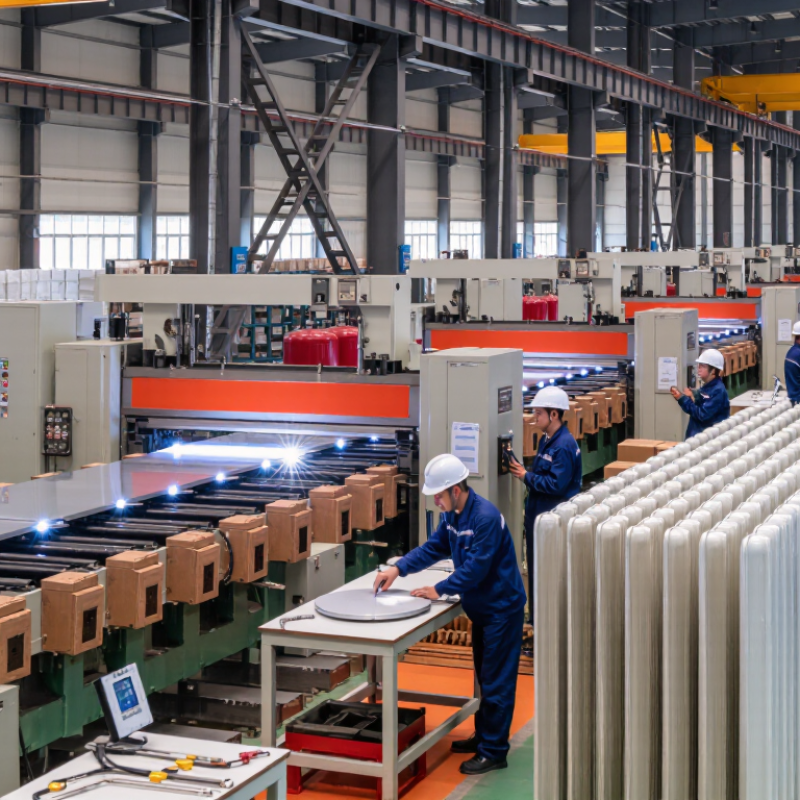
Manufacturers usually form cold-rolled, low-carbon steel sheets with automated roll-forming equipment. Resistance welding joins panels and convector fins with consistent spacing. Some advanced lines use robotic welding, reducing uneven seams and visible distortion. Hydraulic pressure testing checks leaks before painting. Powder coating normally includes degreasing, phosphate treatment, electrostatic spraying, and oven curing. The surface should feel smooth, with no bubbles or exposed edges. Small defects matter.

Reliable suppliers also maintain batch traceability. A serial code should connect the radiator to its steel coil, welding shift, coating record, and inspection result. Thermal output testing needs calibrated equipment and controlled water temperatures. Packaging deserves attention too. Corner protectors and moisture-resistant wrapping reduce damage during ocean transport. However, certification alone is not enough. A capable supplier can explain failed samples and corrective actions clearly. Some factories still depend heavily on manual inspection, which creates inconsistency. My own audits are not perfect either; factory conditions can change after approval. Regular sampling, independent testing, and honest communication remain necessary when comparing Chinese steel panel radiator manufacturers.

What Are China Top Steel Panel Radiator Manufacturers? - Key Manufacturing Standards and Technologies Used by Chinese Suppliers

A practical, non-brand comparison of commonly used standards, materials, production methods and quality-control requirements among Chinese steel panel radiator suppliers.

Evaluation Dimension Common Practice Among Chinese Suppliers Relevant Standard or Technical Reference How Buyers Can Verify It
Product construction Water-filled radiators generally use two profiled steel panels joined with welded convector fins. Typical configurations are Type 10, 11, 21 and 22. EN 442 product classification and testing framework. Check the product drawing, panel arrangement, fin geometry, connection locations and declared heat-output table.
Steel sheet material Low-carbon cold-rolled steel is widely used. A frequently specified European grade is DC01 or an equivalent grade agreed in the purchase specification. EN 10130 for cold-rolled low-carbon steel flat products; the supplier’s material specification may identify an equivalent national grade. Request the steel mill certificate, chemical composition, yield strength, tensile strength and sheet-thickness inspection report.
Panel thickness Many commercial designs specify approximately 1.1–1.5 mm panel steel, while the exact value depends on pressure rating, size and design approval. Purchasing specification and approved product drawing; thickness is not interchangeable between all models. Measure multiple locations with a calibrated micrometer and compare results with the approved drawing and tolerance.
Panel forming Automated roll forming or press forming creates water channels, edges and connection areas with repeatable dimensions. Controlled manufacturing process based on the approved engineering drawing and dimensional tolerances. Review process-control records, first-article measurements and dimensional inspection results for width, height, depth and connection pitch.
Welding technology Resistance spot welding is commonly used for panel-to-fin and panel-to-panel joints; automated welding improves consistency on high-volume lines. Welding parameters should be controlled through documented work instructions and inspection plans. Ask for weld-parameter records, electrode-maintenance logs, sample cross-sections and evidence of leakage testing after welding.
Corrosion pretreatment Cleaning, degreasing and phosphating or another conversion treatment are commonly used before primer and topcoat application. The pretreatment chemistry and coating system should be defined in the technical specification and environmental-control plan. Verify bath concentration, temperature, pH, line speed and periodic coating-adhesion or corrosion-test records.
Coating system A typical system uses an electrophoretic or spray-applied primer followed by thermoset powder coating, often cured in an oven. Coating performance should be agreed by thickness, adhesion, appearance and corrosion-resistance requirements. Check coating thickness, cross-cut adhesion, gloss, color tolerance and salt-spray results where required by the project.
Heat-output rating Heat output is declared for a specified mean water-to-room temperature difference. Common European declarations use ΔT50, but the test conditions must be stated. EN 442-1 and EN 442-2; output depends on water temperature, room temperature, installation and radiator size. Request an accredited or traceable test report showing test conditions, correction factors, uncertainty and measured output.
Pressure and leakage testing Finished radiators are normally pressure-tested with water or air to identify leaks in panels, welds and threaded connections. EN 442 includes pressure-test requirements; the exact test pressure and duration depend on the declared operating pressure and model. Confirm test pressure, hold time, test medium, calibration status and batch-level test records. Do not accept a generic “100% tested” claim without evidence.
Operating pressure Residential steel panel radiators are often designed for operating pressures around 10 bar, while some models are rated differently for specific markets. The rated working pressure, test pressure and maximum temperature must be stated on the technical datasheet. Compare the rating plate, datasheet, test report and installation manual; ensure they match the project’s hydronic-system requirements.
Connection options Common options include side connections and compact or bottom connections, with connection sizes and spacing selected for the target market. Connection dimensions are controlled by the approved drawing; valve compatibility may reference EN 215 where thermostatic radiator valves are supplied. Verify thread type, center-to-center dimensions, air vent, blanking plug, brackets and valve compatibility using physical samples.
Dimensional quality control Factories typically inspect height, length, depth, squareness, connection position, surface flatness and bracket alignment. Inspection criteria should be defined in the approved drawing, control plan and sampling procedure. Request inspection records and conduct pre-shipment sampling with calibrated tools and an agreed acceptance-quality limit.
Quality-management system Export-oriented manufacturers commonly operate documented quality systems covering purchasing, production, inspection, nonconformance and corrective action. ISO 9001 is the principal quality-management reference; certification scope and validity must be checked. Validate the certificate number, scope, issuing body and expiry date through the certification body or official registry.
Environmental and workplace controls Larger plants may manage environmental impacts, chemical handling, wastewater, energy use and occupational safety through formal procedures. ISO 14001 and ISO 45001 may be used where specified by the buyer or supply chain. Review current certificates, chemical-management records, wastewater permits and factory safety procedures during an audit.
Packaging and export protection Radiators are commonly protected with corner guards, film, cartons or pallets; packaging should prevent coating damage and deformation during sea transport. Packaging requirements should reflect the transport route, stacking method, moisture exposure and destination regulations. Approve a packaging sample, verify pallet stability and conduct loading inspections with photographs before shipment.

Note: The values and practices shown are typical industry specifications and verification points, not a ranking or certification claim for any particular manufacturer. Final requirements should be confirmed against the applicable market standard, approved drawing and purchase contract.

How to Compare China’s Steel Panel Radiator Manufacturers

Comparing China’s steel panel radiator manufacturers requires more than checking catalog prices. In factory reviews, I look at steel thickness, welding consistency, coating adhesion, and pressure-test records. A clean production line matters, but documented process control matters more. Ask how sheets are formed, how radiators are leak-tested, and whether each batch receives traceable inspection data. Cheap is not always efficient.

Heating output should be compared under the same test conditions, not copied from attractive product tables. Request performance data linked to recognized technical standards, with inlet temperature, room temperature, and flow rate clearly stated. Check panel types, convector fins, valve positions, surface finishes, and available connection sizes. Samples can reveal uneven paint, sharp edges, weak brackets, or noisy water flow. These details are easy to miss online.

A dependable manufacturer should explain material sourcing, quality controls, packaging, lead times, and warranty limits without vague promises. Review factory capacity against your order volume; a large facility may still delay customized batches. Ask for recent inspection reports and contactable project references while protecting confidential information. I have learned that responsive communication is useful, but it cannot replace evidence. Some comparisons remain imperfect because test methods and after-sales records vary. Leave room for a small pilot order before committing to full production.

Selecting the Right Chinese Manufacturer for Your Heating Project

What Are China’s Top Steel Panel Radiator Manufacturers?

Selecting the Right Chinese Manufacturer for Your Heating Project

Choosing a Chinese steel panel radiator manufacturer requires more than comparing unit prices. My project experience shows that production consistency matters most when radiators arrive in different batches. Ask for factory photographs, quality records, and recent test reports before signing a contract.

Check the steel grade, panel thickness, welding method, and coating process. A reliable factory should explain each step clearly. It should also provide pressure-test records and performance data based on recognized heating standards. Confirm whether the stated heat output matches your operating temperature, room size, and system pressure.

Visit the facility if the order is large. Watch how workers inspect welds, remove oil, and pack finished panels. Small details matter. Poor packaging can damage corners before installation. Request a sample radiator and measure its dimensions, coating thickness, and connection positions. Compare the sample with the approved drawing.

Communication is another practical test. Can the technical team answer questions without vague promises? Can they manage changes in valve positions or mounting brackets? Some suppliers offer low prices but weak after-sales support. That becomes expensive later. No manufacturer is perfect, and I have sometimes trusted attractive samples too quickly. A second inspection would have exposed uneven coating or unclear tolerances. Leave time for corrections, independent inspection, and realistic production schedules.